
What Are Adaptogens? A Beginner’s Guide to Nature’s Stress Fighters
What Is an Adaptogen?
An adaptogen is a plant or mushroom that helps the body adapt to stress — physical, mental, or environmental — without disrupting normal function. Unlike stimulants, which push the nervous system in one direction, adaptogens work bidirectionally: they can calm an overstimulated system or energize a depleted one, depending on what the body needs at that moment.
The concept was formalized by Soviet researcher Nikolai Brekhman in the 1960s, and today adaptogens are among the most studied categories in natural medicine. Ashwagandha, Rhodiola, and Ginseng alone have hundreds of clinical studies between them.
The term “adaptogen” is widely overused in wellness marketing. This guide covers only herbs with documented adaptogenic mechanisms and at least some human trial evidence behind them.
What Qualifies as an Adaptogen?
To meet the scientific definition (Brekhman & Dardymov, 1969), a substance must satisfy three specific criteria — all three, not just one:
| Non-toxic | Safe for daily, long-term use at therapeutic doses. No significant side effects at normal intake levels. |
|---|---|
| Non-specific | Must increase resistance to a broad range of stressors — physical, chemical, and biological — not just one specific type. |
| Normalizing | Must support homeostasis regardless of the direction of the stress. Calming when the body is overstimulated; energizing when it is depleted. |
That third criterion — normalizing — is what separates adaptogens from stimulants or sedatives. A stimulant makes you more alert whether or not you need it. An adaptogen responds to context.
How Adaptogens Work in the Body
Most adaptogens act on the HPA axis — the hormonal communication system between the hypothalamus, pituitary gland, and adrenal glands that governs the stress response. When you face a stressor, the HPA axis triggers cortisol release. Short-term, this is useful. Chronic activation leads to fatigue, immune suppression, mood disruption, and poor sleep.
Adaptogens modulate this response in two ways: they blunt the cortisol spike under acute stress, and they support recovery of normal cortisol rhythms when the system has been chronically activated. The result is improved resilience over time — not a quick fix, and not sedation.
The Key Adaptogens Explained
For Energy, Performance & Focus
More stimulating in profile — best suited to fatigue, mental performance, and physical endurance.
1. Rhodiola (Rhodiola rosea)
The most studied adaptogen for mental performance under pressure — particularly effective for fatigue, burnout, and stress-driven cognitive decline.
- How it works→Salidroside and rosavins modulate serotonin, dopamine, and cortisol — improving cognitive performance and endurance under load
- Best for→Mental fatigue, burnout, exam or work pressure, athletic performance
- Onset→Relatively fast — some effects noticeable within 1–2 weeks
- Caution→Mildly stimulating — morning use only. Avoid in bipolar disorder and with antidepressants.
2. Ginseng (Panax ginseng)
The original adaptogen — used in Chinese medicine for over 2,000 years and one of the most extensively trialled herbs in natural medicine.
- How it works→Ginsenosides modulate the HPA axis, support immune function, and have mild anabolic effects on energy metabolism
- Best for→General fatigue, immune support, cognitive performance in older adults, sexual vitality
- Onset→2–4 weeks; traditionally used in cycles (8–12 weeks on, then a break)
- Caution→Can raise blood pressure at high doses. Avoid with blood thinners. Morning use preferred.
3. Eleutherococcus (Eleutherococcus senticosus — Siberian Ginseng)
The milder alternative to Panax ginseng — a good entry point for beginners, with a particular strength in physical endurance and immune resilience.
- How it works→Eleutherosides support adrenal function and immune regulation — similar broad-spectrum effect to Panax ginseng but less stimulating
- Best for→Physical endurance, recovery from illness, immune resilience, general vitality
- Onset→2–4 weeks
- Caution→Generally well tolerated. Avoid with immunosuppressants. Do not use during acute infection.
4. Maca (Lepidium meyenii)
A Peruvian root with a uniquely nutritional adaptogenic profile — energy and hormonal benefits without the stimulant character of ginseng or rhodiola.
- How it works→Unique glucosinolates and macamides appear to support hormonal balance indirectly — without direct hormonal activity
- Best for→Energy, libido, mood, hormonal balance — particularly studied in perimenopause
- Onset→4–8 weeks for hormonal effects; energy benefits may be felt sooner
- Caution→Avoid with hormone-sensitive conditions until more data is available. Generally well tolerated.
For Calm, Recovery & Sleep
More calming in profile — best suited to anxiety, chronic stress, burnout recovery, and sleep disruption.
5. Ashwagandha (Withania somnifera)
The most widely studied adaptogen in the West — and the strongest evidence base for cortisol reduction, anxiety, and stress-related sleep disruption.
- How it works→Withanolides reduce cortisol, modulate GABA receptors, and regulate HPA axis activity — producing measurable reductions in anxiety markers in human trials
- Best for→Chronic stress, anxiety, sleep disruption, exercise recovery, testosterone support in men
- Onset→Cortisol reductions measurable within 2 weeks; full effects at 4–8 weeks
- Caution→Avoid during pregnancy and with thyroid medication. May cause digestive discomfort at high doses.
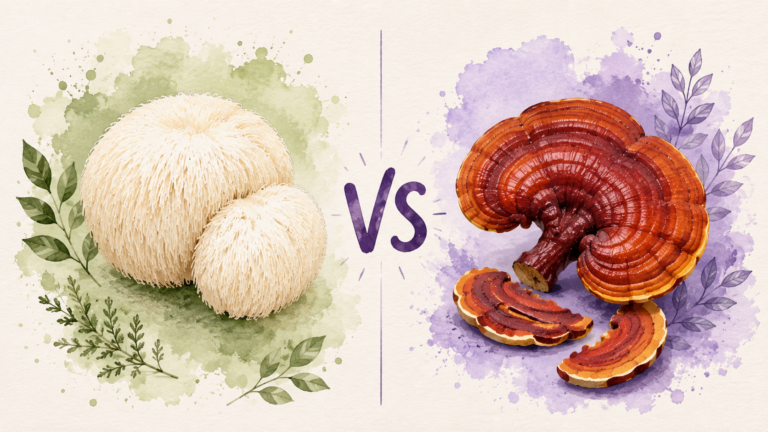
6. Reishi (Ganoderma lucidum)
The only fungal adaptogen on this list — Reishi’s immune-modulating, anti-inflammatory, and sleep-supporting properties make it a natural complement to herbal adaptogens.
- How it works→Triterpenes modulate the stress response and support sleep; beta-glucans regulate immune function — an unusually broad compound profile
- Best for→Chronic stress with immune impact, sleep disruption, inflammation linked to stress load
- Onset→2–6 weeks; sleep improvements may be noticed relatively quickly
- Caution→Interactions with blood thinners and immunosuppressants. Consult a doctor if on medication.
Quick Comparison
| Adaptogen | Best for | Profile | Onset |
|---|---|---|---|
| Energy, Performance & Focus | |||
| Rhodiola | Burnout, mental fatigue, endurance | Stimulating | 1–2 weeks |
| Ginseng | General fatigue, immune support, libido | Stimulating | 2–4 weeks |
| Eleutherococcus | Endurance, immunity, recovery | Mild | 2–4 weeks |
| Maca | Energy, libido, hormonal balance | Mild | 4–8 weeks |
| Calm, Recovery & Sleep | |||
| Ashwagandha | Anxiety, cortisol, sleep, recovery | Calming | 2–8 weeks |
| Reishi | Stress, immunity, sleep quality | Calming | 2–6 weeks |
Which Adaptogen Should You Start With?
- Stressed and exhausted but wired→Ashwagandha — the strongest evidence for cortisol reduction and anxiety. Best starting adaptogen for most people dealing with modern burnout
- Mentally fatigued, struggling to focus→Rhodiola — fastest onset of the group, well-studied for cognitive performance under stress. Morning use.
- General low energy and immune resilience→Eleutherococcus — the gentlest option, a good choice if you’re new to adaptogens or sensitive to stimulants
- Poor sleep driven by chronic stress→Ashwagandha or Reishi in the evening — both have documented sleep benefits through different mechanisms
- Low libido or hormonal imbalance→Maca for both men and women; Ginseng for men specifically — both have clinical support for this indication
- Stress with frequent illness→Reishi — uniquely bridges the stress response and immune modulation, covering both concerns simultaneously
Start with one adaptogen, not several. It’s tempting to stack multiple adaptogens immediately, but starting with one for 6–8 weeks lets you observe the actual effect clearly. Once you know how your body responds, adding a second one becomes a more informed decision.
Safety & What to Watch For
Most adaptogens are well tolerated for long-term use at standard doses — that is part of the definition. However, “natural” does not mean “without risk,” and several important cautions apply.
Drug interactions to know: Rhodiola and Ginseng can interact with antidepressants (SSRIs, MAOIs). Reishi potentiates blood thinners. Ashwagandha may affect thyroid hormone levels. If you take prescription medication, check interactions before starting any adaptogen.
- Pregnancy & breastfeeding→Most adaptogens are not recommended during pregnancy — insufficient safety data for several, and some have documented uterine effects. Avoid unless directed by a physician
- Autoimmune conditions→Immune-modulating adaptogens (Ginseng, Eleutherococcus, Reishi) may be contraindicated — discuss with your doctor before use
- Stimulating adaptogens at night→Rhodiola and Ginseng can disrupt sleep if taken in the afternoon or evening. Morning use only for these two
- Children→Adaptogens are not studied in children and should not be used without medical supervision
- Cycling vs. continuous use→Ginseng is traditionally cycled (on for 8–12 weeks, then a break). Others like Ashwagandha and Reishi are generally used continuously at standard doses