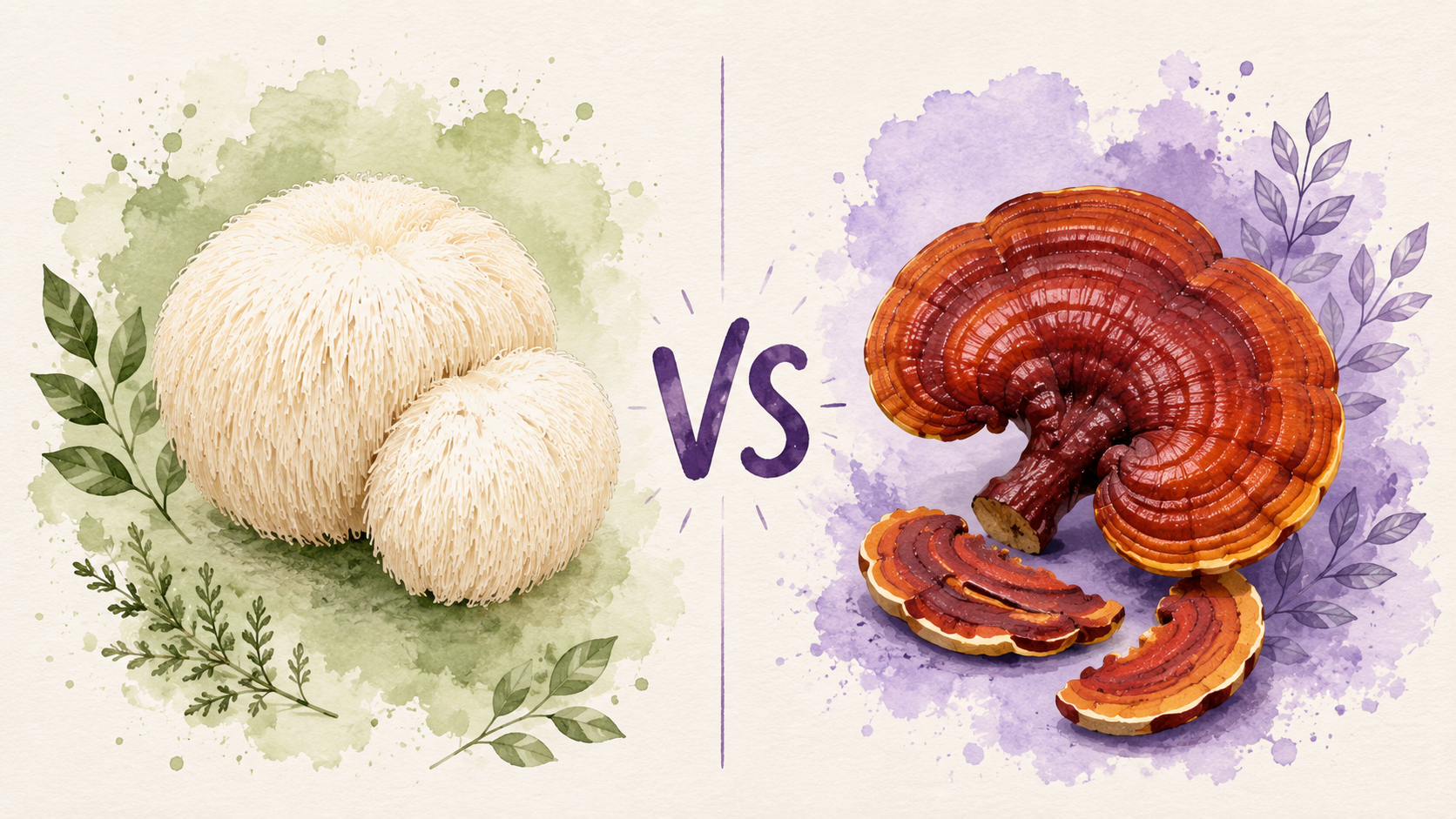
Lion’s Mane vs Reishi: Two Medicinal Mushrooms With Very Different Superpowers
Same Kingdom, Very Different Jobs
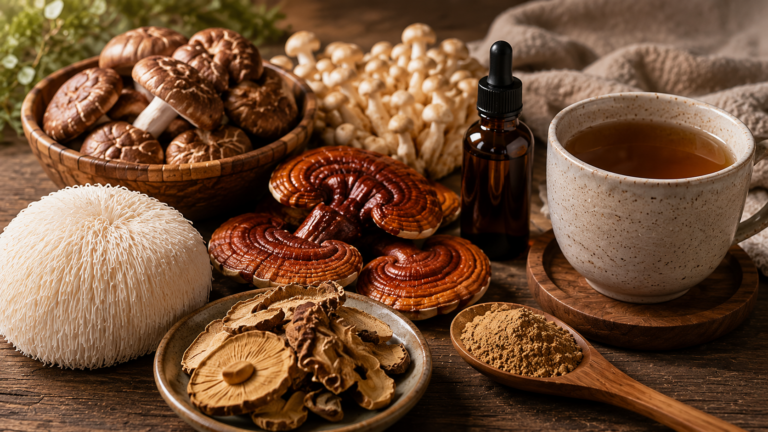
Lion’s Mane and Reishi are both medicinal mushrooms, both well-studied, and both found in the same supplement aisles. Beyond that, they have almost nothing in common.
Lion’s Mane targets the brain. Its unique compounds stimulate Nerve Growth Factor — supporting neurons, memory, and cognitive function. Reishi targets the immune system and the stress response — its compounds modulate immune cells, regulate inflammation, and improve sleep quality.
The question is not which mushroom is better. It’s which one matches your goal — or whether you need both.
At a Glance
| Lion’s Mane | Reishi | |
|---|---|---|
| Primary target | Brain & nervous system | Immune system & stress response |
| Key compounds | Hericenones, erinacines | Beta-glucans, triterpenes (ganoderic acids) |
| Main mechanism | Stimulates Nerve Growth Factor (NGF) | Immune modulation + HPA axis support |
| Best time to take | Morning | Evening |
| Time to notice effects | 4–8 weeks | 2–6 weeks |
| Extraction needed | Hot water or dual extract | Dual extract essential |
Lion’s Mane in Depth
How It Works
Lion’s Mane is the only known natural source of hericenones and erinacines — two compounds that stimulate Nerve Growth Factor synthesis through different pathways. NGF is a protein that supports the survival, growth, and maintenance of neurons. Without adequate NGF, nerve cells deteriorate over time.
Hericenones are found primarily in the fruiting body; erinacines primarily in the mycelium. A product made from only one source may have an incomplete compound profile — this matters more with Lion’s Mane than with most other mushrooms.
- Cognitive function→Improved memory and focus — clinical trials in mild cognitive impairment show statistically significant improvements with daily use
- Nerve repair→Erinacines promote myelin sheath regeneration — studied for peripheral neuropathy and recovery from nerve damage
- Mood→Small trials show reduction in anxiety and depression symptoms, possibly via hippocampal NGF pathways
- Gut health→Supports gut lining integrity and beneficial microbiota — the gut-brain NGF connection is an active research area
- Best used→Morning, daily, minimum 4–8 weeks. Effects are cumulative — not perceptible after a single dose
What to look for on the label: a dual-source extract listing both fruiting body and mycelium, or a standardized fruiting body extract with verified hericenone content. Products labeled “mycelium biomass on grain” are largely starch and unlikely to have meaningful active compound levels.
Reishi in Depth
How It Works
Reishi contains two distinct categories of active compounds — beta-glucans and triterpenes — that require different extraction methods to access. Beta-glucans bind to receptors on immune cells and regulate their activity. Triterpenes (primarily ganoderic acids) inhibit inflammatory signaling, support the HPA axis under stress, and have mild sedative properties that translate to measurable sleep improvements.
A hot-water-only Reishi product delivers beta-glucans but none of the triterpenes. Only a dual-extract (hot water + alcohol) captures the full compound profile.
- Immune modulation→Regulates NK cells, macrophages, and T-cells — effective for both underactive and overactive immune states
- Anti-inflammatory→Triterpenes inhibit NF-κB signaling — one of the central inflammatory pathways involved in chronic disease
- Adaptogenic→Supports HPA axis regulation; reduces the physiological impact of chronic stress without stimulation
- Sleep quality→Ganoderic acids increase total sleep time and reduce sleep onset latency — clinical evidence supports this effect
- Best used→Evening, daily, long-term. Immune benefits build over weeks; sleep improvements may be noticed sooner
Always choose dual-extract Reishi. If the label does not mention both hot water and alcohol extraction, assume the triterpenes — responsible for adaptogenic and sleep effects — are absent. This is the single most important thing to check when buying Reishi.
Head-to-Head Comparison
| Lion’s Mane | Reishi | |
|---|---|---|
| Target & Mechanism | ||
| Primary target | Brain & nervous system | Immune system & stress response |
| Unique compounds | Hericenones, erinacines | Beta-glucans, ganoderic acids |
| Key mechanism | Stimulates NGF synthesis | Immune modulation + HPA axis support |
| Use & Timing | ||
| Best time to take | Morning | Evening |
| Onset of effects | 4–8 weeks minimum | 2–6 weeks |
| Extraction needed | Hot water or dual extract | Dual extract essential |
| Evidence & Safety | ||
| Human trial evidence | Moderate — growing body of research | Strong — among the most studied mushrooms |
| Main caution | Rare allergic reactions; start low | Interactions with blood thinners, immunosuppressants |
| Can you combine them? | Yes — different targets, no conflict. Morning Lion’s Mane + evening Reishi is a well-matched daily stack | |
Which One Is Right for You?
- Brain fog, memory or focus→Lion’s Mane — the NGF mechanism directly supports cognitive function. Take in the morning, commit to at least 6 weeks
- Chronic stress or burnout→Reishi — adaptogenic compounds support HPA axis regulation and reduce the physiological cost of sustained stress
- Poor sleep quality→Reishi in the evening — ganoderic acids have measurable effects on sleep onset and total sleep time
- Frequent illness or low immunity→Reishi — immune modulation via beta-glucans is its most consistently documented benefit
- Nerve damage or neuropathy→Lion’s Mane — erinacines support myelin sheath repair and have been specifically studied for peripheral nerve recovery
- General wellness stack→Both — they target entirely different systems and work well together. Lion’s Mane in the morning, Reishi in the evening
Can You Take Both Together?
Yes — and it is one of the most commonly recommended medicinal mushroom combinations. Because Lion’s Mane and Reishi work through entirely different mechanisms targeting different systems, there is no competition or conflict between them.
The timing also separates naturally: Lion’s Mane supports morning cognitive clarity and focus, while Reishi‘s adaptogenic and sleep-supporting properties make it better suited to evening use. Many commercial blends combine both in a single capsule — these work well for immune and adaptogenic benefits, but if cognitive support is your primary goal, taking Lion’s Mane separately in the morning is preferable to a combined evening formula.
Safety & Precautions
Reishi drug interactions: Reishi can potentiate blood thinners (warfarin, aspirin) and interact with immunosuppressant medication. If you take either, consult your doctor before starting supplementation.
- Mushroom or mold allergy→Start with the lowest available dose and watch for reactions — cross-reactivity is possible with both mushrooms
- Lion’s Mane — rare reactions→Occasional reports of skin rash or digestive discomfort at higher doses; discontinue if symptoms appear
- Reishi at high doses→Extended high-dose use has been associated with liver enzyme elevation in isolated cases. Standard supplement doses (1–3 g extract/day) are well tolerated
- Autoimmune conditions→Reishi‘s immune modulation may be contraindicated in some autoimmune conditions — discuss with your doctor before use
- Pregnancy & breastfeeding→Insufficient safety data for both mushrooms. Avoid unless directed by a physician