Best Herbs for Anxiety and Stress Relief: A Complete Guide
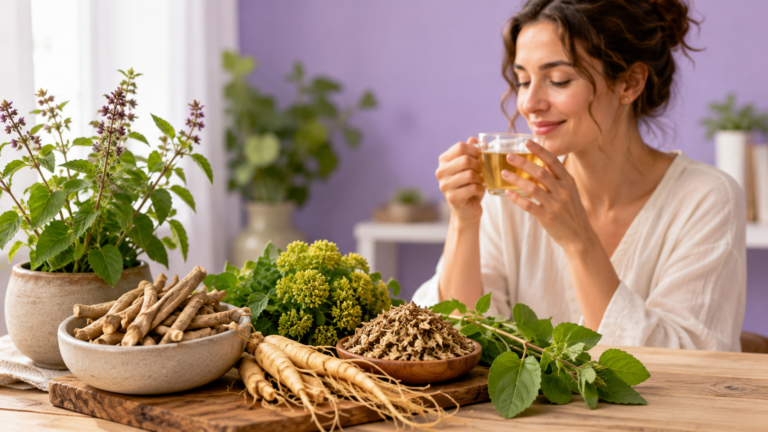
Stress and anxiety are among the most common health concerns today — and for many people, herbs offer a natural complement to lifestyle changes and professional care. Used for centuries in Ayurveda, traditional Chinese medicine and European herbalism, certain plants have a long track record for supporting a calmer, more resilient nervous system.
This guide covers seven herbs most consistently associated with stress and anxiety relief, what makes each one distinctive, and how to find the right match for your situation.
This article is for informational purposes only. Always consult a healthcare professional before starting any herbal supplement, especially if you are pregnant, taking medication, or have an existing health condition.
Two Types of Stress-Relieving Herbs
Not all stress herbs work the same way. Before exploring the list, it helps to understand the two broad categories — because the right choice depends on whether you are dealing with chronic, ongoing stress or acute, situational anxiety.
Adaptogens build long-term resilience; calming herbs address tension and anxiety in the moment.
| Adaptogens | Work over weeks to regulate the stress response. Best for chronic stress, fatigue and burnout. Examples: Ashwagandha, Rhodiola, Holy Basil. |
|---|---|
| Calming herbs | Promote relaxation and reduce acute anxiety, often within hours. Best for situational stress, nervous tension and sleep disturbances. Examples: Valerian, Passionflower, Lemon Balm, Lavender. |
The 7 Best Herbs for Anxiety and Stress
Adaptogens — for chronic stress and long-term resilience
Take daily over several weeks. Effects build gradually.
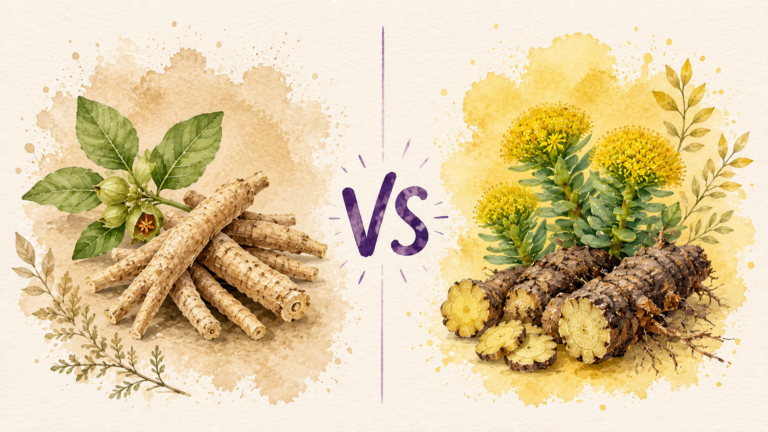
1. Ashwagandha
The most studied adaptogen for chronic stress — best suited for sustained support over several weeks.
- How it works→Helps regulate cortisol levels and supports the HPA axis, the body’s central stress-response system.
- Best for→Ongoing stress, fatigue, low energy, difficulty concentrating.
- Typical form→Standardised root extract (KSM-66 or Sensoril); capsules or powder.
- Caution→Avoid during pregnancy and with hyperthyroidism. Not suitable for people with Solanaceae allergy.
2. Rhodiola Rosea
An adaptogen with a particular affinity for mental fatigue and stress-related burnout.
- How it works→Rosavins and salidroside are thought to influence serotonin and dopamine pathways alongside cortisol regulation.
- Best for→Mental exhaustion, stress combined with low motivation or mood, demanding cognitive periods.
- Typical form→Standardised extract (3% rosavins / 1% salidroside is a common ratio); capsules.
- Caution→Mild stimulating effect — some people find it too activating if taken late in the day. Avoid during pregnancy.
3. Holy Basil (Tulsi)
A gentler adaptogen with a long Ayurvedic tradition — well suited to daily use as a calming tonic.
- How it works→Eugenol and ocimumosides in the leaves are thought to modulate cortisol and support mood stability.
- Best for→Mild chronic stress, general anxiety, support during periods of change or overwork.
- Typical form→Fresh or dried leaf infusion (tea), capsules, tincture.
- Caution→May interact with anticoagulant medications. Avoid during pregnancy.
Calming Herbs — for acute anxiety and immediate relief
Effects felt within hours. Best for situational stress and sleep.
4. Valerian
The most widely used calming herb in Western herbalism, particularly when anxiety disrupts sleep.
- How it works→Valerenic acid in the root is thought to interact with GABA receptors, the same pathway targeted by many anti-anxiety medications.
- Best for→Nervous tension, difficulty falling asleep, restlessness linked to stress.
- Typical form→Dry root extract capsules; infusion (note: strong distinctive odour).
- Caution→Causes drowsiness — do not drive after use. Not recommended for liver disorders or children under 12. Limit to six weeks continuous use.
5. Passionflower
A fast-acting calming herb particularly useful for anxiety with a physical component — tension, racing heart, restlessness.
- How it works→Flavonoids (mainly chrysin) are thought to act on GABA-A receptors, producing a calming and mildly sedative effect.
- Best for→Acute anxiety, pre-event nerves, mild anxiety with palpitations or muscle tension.
- Typical form→Infusion, tincture, capsules.
- Caution→Avoid during pregnancy. May enhance the effect of sedative medications.
6. Lemon Balm
The mildest herb on this list — gentle enough for daily use and often the best starting point for those new to herbal stress relief.
- How it works→Rosmarinic acid inhibits GABA transaminase, allowing GABA to remain active longer in the brain.
- Best for→Mild anxiety, digestive upset linked to stress, improving mood and focus under pressure.
- Typical form→Fresh or dried leaf infusion, capsules, tincture.
- Caution→May affect thyroid hormone activity at high doses — use with caution alongside thyroid medication.
7. Lavender
Unique on this list for having a well-supported oral form alongside its more familiar aromatic use.
- How it works→Linalool and linalyl acetate modulate calcium channels and GABA receptors; oral standardised extracts (Silexan) have been studied in clinical trials for generalised anxiety.
- Best for→Mild to moderate anxiety, nervous tension, restless sleep. Aromatherapy for situational stress.
- Typical form→Oral standardised extract (Silexan 80 mg); essential oil for aromatherapy only.
- Caution→Essential oil must not be ingested. Oral extract may cause mild nausea or burping.
Quick Comparison
Use this table as a reference to compare the seven herbs at a glance.
| Herb | Best for | Onset |
|---|---|---|
| Adaptogens | ||
| Ashwagandha | Chronic stress, fatigue, cortisol regulation | Weeks |
| Rhodiola Rosea | Mental fatigue, burnout, stress with low mood | Weeks |
| Holy Basil | Mild daily stress, general anxiety, tonic use | Weeks |
| Calming Herbs | ||
| Valerian | Anxiety disrupting sleep, nervous tension, restlessness | Hours |
| Passionflower | Acute anxiety, palpitations, physical tension | Hours |
| Lemon Balm | Mild anxiety, stress-related digestive symptoms, beginners | Hours |
| Lavender | Generalised anxiety, nervous tension, restless sleep | Hours / weeks (oral) |
Which One Is Right for You?
The best herb depends less on general rankings and more on your specific pattern of stress. Use the guide below as a starting point.
- Chronic stress + fatigue→Ashwagandha or Rhodiola — both adaptogens designed for long-term daily use.
- Stress disrupting sleep→Valerian is the most studied option; Passionflower is a good alternative if Valerian feels too sedating.
- Acute or situational anxiety→Passionflower or Lavender — both work relatively quickly.
- Stress with digestive symptoms→Lemon Balm has a particular affinity for stress-related gut discomfort.
- New to herbal supplements→Lemon Balm or Holy Basil — the gentlest options, widely tolerated and easy to take as tea.
- Stress combined with low mood→Rhodiola has the most evidence for this combination among adaptogens.
Start with one herb at a time and give it at least 3–4 weeks before drawing conclusions. Adding multiple herbs simultaneously makes it harder to know what is working.
A Note on Safety
All herbs on this list are generally well tolerated when used as directed, but no natural ingredient is entirely without risk. Several interact with medications — particularly sedatives, antidepressants, thyroid drugs and anticoagulants — and most are not recommended during pregnancy or breastfeeding. For detailed safety information and dosage, visit each herb’s individual profile.
If you are taking any prescription medication or have an existing health condition, consult a healthcare professional before adding any herbal supplement to your routine. See our Medical Disclaimer.