
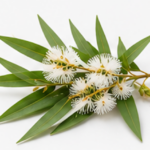
Niaouli
An aromatic leaf oil prized for antiseptic and respiratory support.
Niaouli (Melaleuca quinquenervia) is a member of the Myrtaceae family native to Madagascar, New Caledonia and Australia. The aromatic leaves and young twigs are distilled for an essential oil rich in 1,8‑cineole (eucalyptol) along with various monoterpenes and sesquiterpenes; the tree is also notable for its papery white bark and five‑nerved glossy leaves.
The essential oil is commonly employed in aromatherapy and topical preparations for its antiseptic, expectorant and skin‑supporting uses, and different chemotypes influence aroma and activity. Individual responses and safety profiles vary by person and formulation, so effects are not guaranteed and appropriate precautions should be observed for sensitive groups.
At a Glance
A Myrtaceae tree valued for an aromatic leaf oil, Niaouli is grown in warm maritime regions and yields a clear essential oil used in topical and inhalation preparations.
The oil is high in 1,8‑cineole and other monoterpenes and is traditionally used for antiseptic, expectorant and skin‑supporting applications.
| Common name |
|
|---|---|
| Scientific name | Melaleuca quinquenervia |
| Plant family | Myrtaceae |
| Origin |
|
| Parts used | Leaves |
| Active compounds |
|
| Main benefits |
|
| Available forms |
|
Origin & History
Niaouli is native to warm coastal regions of Madagascar, New Caledonia and parts of Australia, where it grows as a tall, paper‑barked tree with glossy, five‑nerved leaves. It favors sunny, humid sites with well‑drained soils and does not tolerate frost, which limits its cultivation to subtropical and tropical climates.
Indigenous peoples of the South Pacific traditionally chewed niaouli leaves to support skin healing and ease bronchial discomfort. Over time the aromatic leaves became valued for the essential oil they yield and the tree came to be cultivated commercially in its native range; the distilled oil later found wider use in topical and inhalation preparations in global aromatherapy and herbal practice.
Composition & Active Compounds
The niaouli tree has a pale, papery bark and glossy leaves with five distinctive veins; the leaves are rich in essential oil composed mainly of oxygenated terpenes and a mix of mono‑ and sesquiterpenes. Leaves are the principal part used for the essential oil, which is dominated by 1,8‑cineole and related monoterpenes that shape the oil’s aroma and functional profile.
- 1,8‑cineole (eucalyptol): an oxygenated monoterpene that largely defines the oil’s aroma and is linked to respiratory and topical uses in traditional and aromatherapeutic contexts
- α‑pinene: a monoterpene contributing a fresh, pine‑like note and volatile activity
- β‑pinene: a monoterpene with resinous, green aroma characteristics
- limonene: a monoterpene with citrus‑like scent that influences volatility and aroma
- α‑terpineol: a monoterpenol with a mild floral scent found in many leaf‑derived essential oils
- viridiflorol: a sesquiterpenol present in lower amounts and noted in literature for potential circulatory‑related activity
Related Herbs

Properties & Effects
Niaouli oil is traditionally known for topical and respiratory uses, and it has been applied in folk and aromatherapeutic practices for skin care and breathing support.
Antiseptic uses for the oil are among its most widely cited traditional and aromatherapy applications.
- Immunostimulant: may support immune responsiveness and is traditionally used for upper respiratory complaints.
- Decongestant: may help relieve nasal congestion and ease blocked sinuses.
- Antiviral: research suggests it may have activity against certain viruses and it is sometimes used early in topical viral episodes.
- Antiseptic: may support topical and respiratory antiseptic use to help limit microbial presence on skin or in airways.
- Expectorant: may help loosen mucus and support expectoration in productive coughs.
- Circulatory support: may support venous and lymphatic circulation and reduce sensations of heavy legs or related discomfort.
- Cicatrizant (wound healing): may support skin repair and help soothe redness and minor skin lesions.
Dosage & How to Use
Traditional dosage examples and common aromatherapy recommendations are summarized below; always follow product labeling and professional guidance.
| Skin infection |
|
|---|---|
| Wound healing |
|
| Bronchial conditions |
|
| Oral use for pulmonary infection or cough |
|
Safety, Side Effects & Contraindications
Certain people should avoid niaouli essential oil because of documented safety concerns and variable individual tolerance. Known precautions include respiratory reactions in people with asthma or respiratory insufficiency and neurologic sensitivity in people with epilepsy; topical use can also cause irritation in some individuals and responses vary by formulation and dose.
Due to components with estrogen‑like activity, niaouli is not recommended for people with hormone‑dependent conditions and should be avoided during pregnancy and breastfeeding unless a clinician advises otherwise. Use with caution around young children and consult a healthcare professional if there is any uncertainty about interactions with existing conditions or medications.
- Pregnancy and lactation: Not recommended during pregnancy or breastfeeding.
- Children under seven: Avoid use in children under seven unless a healthcare professional advises otherwise.
- Asthma or respiratory insufficiency: Not recommended for people with asthma or respiratory failure.
- Epilepsy: Not recommended for people with epilepsy.
- Hormone‑dependent cancer: Avoid in cases of hormone‑dependent cancers because of estrogen‑like activity.
Niaouli essential oil has known contraindications (pregnancy, breastfeeding, young children, asthma, epilepsy, hormone‑dependent cancers); consult a healthcare professional before use, especially if pregnant, nursing, taking medications, or managing chronic conditions.