Medicinal Mushrooms: A Complete Guide to Benefits, Uses, and How to Choose
Why Medicinal Mushrooms Are Different From Superfoods
Mushrooms occupy their own biological kingdom, separate from plants and animals. Their biochemistry is unique, their compounds structurally unlike anything in plants, and their effects on the human immune system are among the most scientifically documented in natural medicine.
This guide covers the four most studied medicinal mushrooms available today — what each does, who benefits, and how to use them effectively.
Context: Medicinal mushrooms are fungi used for therapeutic purposes — distinct from culinary mushrooms (though some overlap). Their active compounds — primarily beta-glucans and triterpenes — have been studied in thousands of clinical and laboratory trials. This is not fringe wellness; it’s one of the most researched areas of natural medicine.
The Key Active Compounds
Before looking at individual mushrooms, it helps to understand the two main categories of medicinal compounds:
| Beta-glucans | Polysaccharides in mushroom cell walls. Primary drivers of immune modulation — bind to receptors on macrophages, NK cells, and dendritic cells. Extracted with hot water. |
|---|---|
| Triterpenes | Bitter compounds unique to certain mushrooms (especially Reishi). Anti-inflammatory, adaptogenic, mildly sedative. Require alcohol extraction to be bioavailable. |
| Hericenones / Erinacines | Found only in Lion’s Mane. Stimulate Nerve Growth Factor (NGF) synthesis — a mechanism not found in any other mushroom. |
| Ergosterol | A Vitamin D precursor found in all mushrooms. Converts to Vitamin D2 when exposed to UV light — why sun-dried mushrooms are a dietary source of D. |
This matters because extraction method determines which compounds you’re getting. Hot-water-only products have beta-glucans but no triterpenes. A dual-extract (hot water + alcohol) captures both. Products made from mycelium grown on grain are mostly starch — much lower in active compounds.
The Four Most Studied Medicinal Mushrooms
1. Reishi (Ganoderma lucidum)
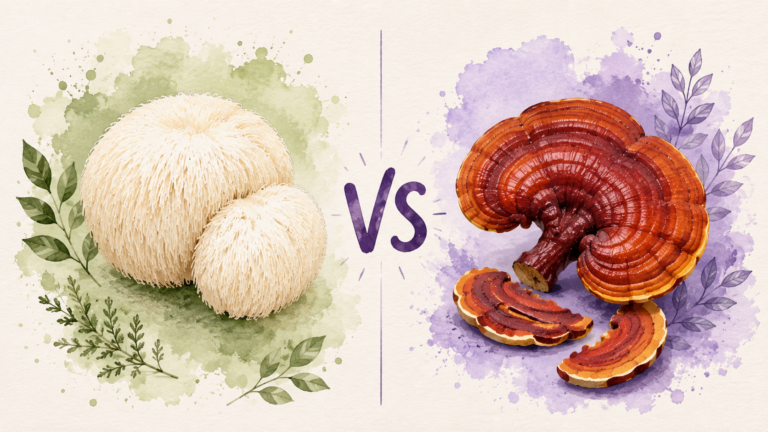
The immune regulator and adaptogen — Reishi’s breadth of action is unmatched among medicinal mushrooms.
- Immune support→Enhances NK cell and macrophage activity; modulates both overactive and underactive immune states
- Anti-inflammatory→Triterpenes reduce NF-κB inflammatory signaling — comparable in some studies to conventional anti-inflammatories
- Adaptogenic→Supports HPA axis regulation; reduces stress-related fatigue
- Sleep→Ganoderic acids promote sleep — one of the few adaptogens appropriate for evening use
- Best used→Daily, long-term, in the evening. Not a quick fix — benefits accumulate over weeks to months
2. Lion’s Mane (Hericium erinaceus)
The neurological mushroom — Lion’s Mane is the only known natural source of compounds that stimulate Nerve Growth Factor in the brain.
- Cognitive support→NGF stimulation supports neuron growth, synaptic plasticity, and memory consolidation
- Nerve repair→Erinacines promote myelin sheath repair — studied for peripheral neuropathy and post-injury recovery
- Mood→Small trials show reduction in depression and anxiety symptoms, possibly via hippocampal NGF pathways
- Gut→Supports gut-lining integrity and beneficial gut bacteria — the gut-brain NGF connection is an active research area
- Best used→Morning. Results require 4–8 weeks minimum of consistent daily use
3. Shiitake (Lentinula edodes)
The most widely consumed medicinal mushroom in the world — Shiitake is both a culinary staple and a legitimate immune-support supplement.
- Immune activation→Lentinan (its unique beta-glucan) is approved in Japan as a cancer adjuvant; enhances T-cell and NK cell activity
- Cardiovascular→Eritadenine compound shown to reduce LDL cholesterol by inhibiting cholesterol absorption
- Antimicrobial→Active against several bacterial and fungal strains in vitro; traditional use for infections
- Vitamin D source→Sun-dried shiitake contains significant Vitamin D2 — one of the few non-animal dietary sources
- Best used→Regularly in cooking (3+ servings per week) or as a daily extract supplement
4. Maitake (Grifola frondosa)
The blood sugar and immune specialist — Maitake contains D-fraction, one of the most studied immune-activating beta-glucans in existence.
- Immune modulation→D-fraction stimulates macrophages and NK cells; studied as an adjuvant in oncology research
- Blood sugar→Shows insulin-sensitizing effects in trials; may help regulate post-meal glucose spikes
- Blood pressure→Some evidence for mild antihypertensive effects — relevant for cardiovascular risk profiles
- Weight→Traditional use for weight management supported by some metabolic research, though human trials are limited
- Best used→With meals, consistently. Particularly relevant for those with metabolic concerns or high immune-support needs
Which Mushroom for Which Goal?
| Goal | Best mushroom(s) | Why |
|---|---|---|
| Cognitive performance | Lion’s Mane | Only mushroom with NGF-stimulating compounds (hericenones + erinacines) |
| Daily immune support | Reishi + Shiitake | Reishi modulates; Shiitake activates. Together they cover both aspects of immune maintenance |
| Stress + sleep | Reishi | Adaptogenic + sleep-supporting triterpenes; the only mushroom with both effects |
| Blood sugar + metabolic | Maitake | D-fraction has the most evidence for insulin sensitization among medicinal mushrooms |
| Cardiovascular health | Shiitake | Eritadenine specifically targets LDL cholesterol; also high in heart-healthy compounds |
| General wellness stack | Lion’s Mane + Reishi | Covers the two most distinct mechanisms: neurological + immune/adaptogenic. Excellent combination |
Safety & Precautions
Drug interactions: Medicinal mushrooms, particularly Reishi and Maitake, can interact with blood thinners (warfarin), immunosuppressants, and diabetes medications. If you take any of these, consult your doctor before supplementing.
- Allergy→Anyone with mushroom or mold allergies should start with very low doses and watch for reactions. Cross-reactivity is possible
- Reishi at high doses→Very high doses have been associated with liver enzyme elevation in rare cases. Stick to standard supplement doses (1–3 g extract/day)
- Maitake + blood sugar medications→May enhance the blood-sugar-lowering effect of diabetes drugs. Monitor levels if you’re on metformin or insulin
- Pregnancy→Insufficient safety data. Avoid medicinal mushroom supplements during pregnancy unless advised by a physician