
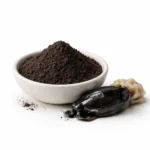
Melanin
A pigment-based supplement that helps prepare skin and accelerate tanning.
Melanin is a natural pigment present in many organisms, notably in human skin, hair and eyes. Eumelanin, the brown-to-black form commonly referred to as melanina, contributes to skin tone and participates in the tanning response by redistributing toward more superficial skin layers after UV exposure. Melanin also displays antioxidant activity and is available in oral supplement formats — for example, Mélaline®, a keratin hydrolysate derived from black sheep wool — formulated to increase pigment availability.
Clinical studies of supplements containing Mélaline® have used a 30-day regimen of 500 mg per day and reported intensified pigmenting responses with regular UVA/UVB exposure, though individual effects may vary. These products are marketed as dietary supplements in capsule form and do not replace standard sun-protection measures; pregnant or breastfeeding people and anyone undergoing medical treatment are advised to consult a healthcare professional before use.
At a Glance
Melanin denotes a group of natural pigments found across many organisms and determines brown-to-black coloration in human skin, hair and eyes.
Eumelanin, the common brown-to-black form, contributes to the tanning response and shows antioxidant activity and is used in oral capsule supplements such as Mélaline® derived from black sheep wool.
| Common name | Melanin, Eumelanin |
|---|---|
| Origin | Various organisms (including humans) |
| Parts used | Wool (black sheep) |
| Active compounds |
|
| Main benefits |
|
| Available forms | Capsule |
Origin & History
Melanin is a generic term for several natural pigments produced across the living world; in humans the eumelanin form largely determines the brown-to-black coloration of skin, hair and eyes. It is synthesized from the amino acid tyrosine under the action of the enzyme tyrosinase and appears microscopically as brown granules measuring under 800 nanometres; the amount and distribution of melanin in skin layers influence visible pigmentation and the tanning response after ultraviolet exposure.
Across cultures, skin pigmentation and tanning have influenced clothing practices, aesthetic preferences and seasonal behaviours related to sun exposure. Observations linking darker pigmentation with sun exposure and protection shaped traditional practices concerning sunbathing, coverings and cosmetic approaches in many societies. Contemporary applications include the development of melanin-rich keratin hydrolysates (for example Mélaline® from black sheep wool) used in capsule supplements to increase pigment availability, a modern technological use rather than an age-old herbal tradition.
Composition & Active Compounds
Melanin appears microscopically as brown granules under 800 nanometres and is a large macromolecule formed by oxidative polymerisation beginning from the amino acid tyrosine under the action of the enzyme tyrosinase. Supplement products typically supply melanin via melanin‑rich keratin hydrolysates rather than pure isolated pigment molecules.
Mélaline®, a keratin hydrolysate obtained from black sheep wool, is the main source used in oral supplement formulations.
- Eumelanin: brown-to-black pigment form responsible for darker skin hair and eye colour
- Melanin macromolecules: large pigment macromolecules forming nanoscale granules
- Tyrosine: amino acid precursor in melanin synthesis
- Tyrosinase: enzyme that catalyses the conversion of tyrosine into melanin


Properties & Effects
Melanin is a natural pigment chiefly recognised for its role in skin, hair and eye colour and for participating in the skin’s response to ultraviolet light.
Research on melanin-containing supplements has most consistently focused on their ability to prepare the skin and accelerate tanning in response to UV exposure.
- Prepares and accelerates tanning: may support the skin’s pigmenting response and help accelerate visible tanning when combined with UV exposure.
- Antioxidant: may support antioxidant activity in the skin and help limit oxidative stress associated with UV exposure.
- Skin quality: may support improvements in skin tone and flexibility.
Dosage & How to Use
Clinical studies of melanin supplements formulated with Mélaline® used a 500 mg daily regimen for 30 days.
| Prepares and accelerates tanning |
|
|---|
Safety, Side Effects & Contraindications
Available data have not established specific contraindications and no dangers were observed in the referenced studies of melanin-containing dietary supplements, though evidence is limited and individual reactions can occur. People with known allergies to wool or keratin may need to exercise caution when using products derived from sheep wool.
Pregnant and breastfeeding people are advised to consult a healthcare professional before beginning melanin supplements, and the same precaution applies to anyone receiving medical treatment because interactions have not been fully studied. Supplements do not replace standard sun-protection measures; consult a health professional for personalised guidance.
- Pregnancy and breastfeeding: consult a healthcare professional before use.
- Concomitant medical treatment: seek medical advice due to limited data on interactions.
Consult a healthcare professional before use if pregnant, breastfeeding or receiving medical treatment; supplements do not replace standard sun-protection measures.