
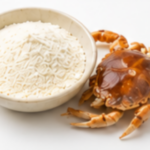
Chitosan
A chitin-derived supplement studied for intestinal fat-binding and weight-management support.
Chitosan is a natural polysaccharide derived from chitin, the structural polymer found in crustacean and mollusk shells. It resists enzymatic digestion and has been widely studied for properties such as intestinal fat-binding, antioxidant activity, and antimicrobial effects. Produced by the deacetylation of chitin, chitosan is commonly formulated as a dietary supplement, often presented in capsule form for use during weight-management regimens.
Research suggests potential effects including reduced lipid absorption, appetite-suppressing volume effects, and modest influences on blood cholesterol in some studies, but uses and outcomes vary by individual and are not guaranteed. Typical supplemental doses reported range from 1,000 to 6,000 mg per day, usually divided across meals and taken shortly before eating with a full glass of water. Chitosan is contraindicated for people with shellfish or mollusk allergies; mild adverse effects such as nausea or constipation have been reported, and medical advice is recommended for those with health concerns or uncertain suitability.
At a Glance
Chitosan is a deacetylated derivative of chitin extracted from the shells of crustaceans and mollusks used in supplements and industrial applications. It resists enzymatic digestion and has been studied for intestinal fat-binding, antioxidant activity, and antimicrobial effects. Effects and uses vary by individual, and products are contraindicated for people with shellfish or mollusk allergies.
| Common name |
|
|---|---|
| Origin | Shells of crustaceans and mollusks |
| Parts used | Whole exoskeleton |
| Active compounds |
|
| Main benefits |
|
| Available forms | Capsule |
Origin & History
Chitosan originates from chitin, a structural polymer found in the exoskeletons of crustaceans, mollusks and some insects; it is obtained industrially by extracting chitin from shells and then deacetylating it to produce the more soluble chitosan. The term chitin traces to a Greek root and was popularized in early chemical descriptions of animal shells, reflecting the molecule’s role in the strength and flexibility of invertebrate exoskeletons.
Japan emerged as an early center for large-scale production and application of chitosan, helping to establish its use in supplements and various industrial fields. Production and research have since expanded in several countries, and modern uses focus on supplement formulations, biomedical and material applications rather than longstanding folk remedies; historical references therefore emphasize the raw material (shells and their uses) and the later scientific development of chitosan through extraction and processing.
Composition & Active Compounds
Chitosan is a deacetylated derivative of chitin and appears as a light-colored, linear polysaccharide whose structure is similar to cellulose; it is composed mainly of units of N-acetyl-D-glucosamine and D-glucosamine and is typically processed into powder for supplement formulation. Chitosan produced from the exoskeletons of crustaceans and mollusks is the primary material used in dietary supplements. These amino-sugar constituents determine chitosan’s solubility and positive charge, which underlie its reported ability to bind lipids and interact with biological surfaces.
- N-acetyl-D-glucosamine: constituent unit of chitin present in chitosan chains
- D-glucosamine: deacetylated unit that contributes to chitosan’s cationic properties
Properties & Effects
Chitosan is traditionally known as a deacetylated derivative of chitin used in supplements and studied for effects on fat binding, antioxidant protection, and microbial control.
Research and clinical interest have most often focused on chitosan’s capacity to bind dietary fats in the gut and its possible role in weight-management support.
- Antioxidant: Research suggests it may support protection against oxidative stress.
- Antimicrobial: Studies indicate it may support control of certain bacterial and fungal growth.
- Weight-management: It may support reduced lipid absorption and increased feelings of fullness when taken with meals.
- Cholesterol-lowering: Some studies suggest it may support modest reductions in blood cholesterol levels.
Dosage & How to Use
Typical supplemental dosing and administration guidance reported in product literature and studies is summarized below.
| Dietary supplement |
|
|---|
Safety, Side Effects & Contraindications
Chitosan should be avoided by people with known allergy to shellfish or mollusks; allergic reactions to the raw material source are explicitly contraindicated. Mild gastrointestinal side effects such as nausea or constipation have been reported, and product labels and studies commonly advise respecting recommended doses and using short-term courses.
Specific interactions with medications are not detailed in the provided facts, so medical advice is recommended before combining chitosan with prescription treatments or when there are underlying health conditions. In all cases, consult a healthcare professional for personalized guidance if there is uncertainty about suitability or potential interactions.
- Allergy to shellfish or mollusks: Avoid use if allergic to crustaceans or mollusks
- Dosage and duration: Respect recommended doses and avoid treatments longer than one month without medical supervision
- Mild gastrointestinal effects: Nausea or constipation may occur in some people
Avoid if allergic to shellfish or mollusks; consult a healthcare professional before use, especially if taking medications or managing health conditions.