
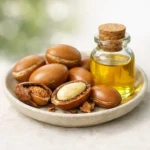
Argan
A nourishing oil traditionally used to condition skin and hair.
Argan (Argania spinosa) is an emblematic Moroccan tree whose fruit yields seeds pressed to produce argan oil. Rich in unsaturated fatty acids (omega‑6 and omega‑9), vitamin E and carotenoids, the oil is valued for its nutritive, antioxidant and regenerating qualities and is used both in culinary preparations and in topical formulations for skin, hair and nails.
Traditionally used by Berber communities, argan oil is commonly applied to dry or mature skin, dull or damaged hair and brittle nails in cosmetic practice. Reported effects vary among individuals and depend on product quality and method of use; when blending with other ingredients, a tolerance test is advisable and professional advice may be appropriate for specific concerns.
At a Glance
Argan is a drought-tolerant tree from southwestern Morocco whose fruit yields seeds pressed into a versatile oil used in both cuisine and topical care.
Rich in unsaturated fatty acids, vitamin E and carotenoids, argan oil is valued for nutritive, antioxidant and regenerating properties.
| Common name |
|
|---|---|
| Scientific name | Argania spinosa |
| Plant family | Sapotaceae |
| Origin | Morocco |
| Parts used | Fruit (seed/almond) |
| Active compounds |
|
| Main benefits |
|
| Available forms |
|
Origin & History
The argan tree (Argania spinosa) is native to southwestern Morocco, occurring on semi‑arid plains and rocky slopes from the Essaouira region to the Souss valley. Adapted to dry conditions, the species produces fruit whose seeds are processed to extract the oil and form distinctive argan woodlands in its natural habitat.
Berber communities have long harvested argan fruit and developed traditional methods for oil extraction used in both cuisine and topical care; the tree is a cultural emblem of the region and its products entered regional trade networks in antiquity. Berber women historically managed argan oil production and used the oil for culinary purposes as well as for skin, hair and nail care in local traditions.
Composition & Active Compounds
Argan is a small to medium tree whose fruits contain a hard seed (often called an almond) from which the characteristic oil is cold‑pressed. The oil is dominated by unsaturated fatty acids (notably omega‑6 and omega‑9) and also contains vitamin E and carotenoids; these constituents underlie the oil’s nutritive, antioxidant and conditioning characteristics and influence its stability and appearance.
The seed (almond) of the argan fruit is the primary part used to produce argan oil, the main form employed in supplements and topical products.
- Unsaturated fatty acids (omega-6, omega-9): contribute to the oil’s lipid profile and emollient properties.
- Vitamin E: a fat-soluble antioxidant associated with protection of lipids from oxidation.
- Carotenoids: pigment compounds with antioxidant potential and influence on oil colour.

Properties & Effects
Argan has a long tradition of topical use for skin, hair and nails and is also consumed as an edible oil in its native region. Its most widely documented role is as a topical conditioning oil for dry or mature skin and for damaged hair.
- Skin and hair care: traditionally used to nourish, hydrate and improve the appearance of dry or mature skin and to condition dry or damaged hair and brittle nails.
- Antioxidant: research suggests it may support skin health and resilience.
- Lipid support: when consumed as a culinary oil, it may support healthy blood lipid levels.
Dosage & How to Use
Below are practical application recommendations for topical uses of argan oil as described in the source facts.
| Skin care |
|
|---|---|
| Hair care |
|
Safety, Side Effects & Contraindications
The provided source does not list formal contraindications and reports no observed side effects for argan oil; nevertheless, standard precautions are recommended. If argan oil is mixed with other products, perform a tolerance (patch) test on the inner elbow to check for local reactions and stop use if irritation occurs. For dietary use, avoid excessive consumption because of the oil’s high lipid content.
The facts do not report specific interactions with medications or particular medical conditions. Individual responses can vary, so seek professional advice if taking prescription medicines or if there are concerns about systemic use.
Consult a healthcare professional before use. Perform a patch test when blending with other products and avoid excessive oral intake due to high fat content.