
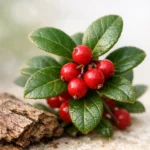
Wintergreen
A concentrated topical oil traditionally used for muscle and joint relief.
Wintergreen (Gaultheria procumbens) is a low-growing North American shrub whose leaves yield an essential oil dominated by methyl salicylate. The oil is traditionally valued in aromatherapy and topical care for its analgesic and anti-inflammatory character; methyl salicylate is structurally similar to acetylsalicylic acid (aspirin).
The leaves and their essential oil are used externally, typically diluted in a vegetable carrier oil — common guidance is about 20% dilution (for example, 1 drop of essential oil to 10 drops of carrier). The oil is not recommended for internal use and is contraindicated in pregnancy, lactation and in young children; it can be irritating, so a patch test on the inner elbow is advised before wider application. Uses, effects and tolerability vary by individual; seek guidance from a qualified healthcare professional for personalized advice.
At a Glance
Wintergreen is a low-growing, evergreen North American shrub whose leaves yield an essential oil dominated by methyl salicylate. The oil and dried leaves are traditionally used externally to support topical relief of muscle and joint discomfort.
Common applications involve diluted essential oil or simple leaf preparations such as infusions; the oil is intended for external use only and may cause irritation in some people. Individual responses and tolerability vary.
| Common name |
|
|---|---|
| Scientific name | Gaultheria procumbens |
| Plant family | Ericaceae |
| Origin | North America |
| Parts used | Leaves |
| Active compounds | Methyl salicylate |
| Main benefits |
|
| Available forms |
|
Origin & History
Wintergreen (Gaultheria procumbens) is native to northern and eastern North America, where it grows as a low evergreen shrub in dry, acidic soils such as pine woods, sandy slopes, coniferous forests and acidic bog margins. The plant produces evergreen, lanceolate leaves, bell-shaped flowers and red berries; the aromatic leaves are valued for an essential oil rich in methyl salicylate.
Indigenous peoples traditionally chewed the leaves to relieve pain and fever, a practice later examined by European and American scientists who identified methyl salicylate as the key constituent. The oil and leaf preparations entered wider folk and therapeutic use for topical relief of muscle and joint discomfort, and common names such as Canada tea and Newfoundland tea reflect local uses of the leaves as an infusion. Cultural traditions and individual responses vary.
Composition & Active Compounds
Wintergreen is a low-growing evergreen shrub with dark green, lanceolate leaves, small bell-shaped white to pink flowers and red berries. The aromatic leaves are the primary source of an essential oil that is almost monomolecular and is dominated by a single salicylate ester; this constituent is widely studied because it underpins the plant’s topical effects and traditional uses.
The leaves are the main part used and the essential oil is highly concentrated in methyl salicylate.
- Methyl salicylate: a salicylate ester present at very high concentrations in wintergreen oil; associated with topical analgesic and anti-inflammatory properties and chemically related to acetylsalicylic acid.
Related Herbs
Properties & Effects
Used in traditional and sports-related topical care, wintergreen is commonly applied to areas of muscle and joint discomfort. Its most notable and well-documented use is as a topical analgesic and anti-inflammatory for localized muscle and joint pain.
- Anti-inflammatory: Research suggests topical use may support reduction of inflammation-related discomfort.
- Analgesic: Traditionally used to help relieve localized muscle and joint pain and soreness.
- Circulation support: May support healthy peripheral circulation and ease sensations of heavy legs.
Dosage & How to Use
Use externally only; dilute the essential oil before application.
| Muscle and joint application |
|
|---|---|
| Massage for circulation (legs) |
|
| Bath additive |
|
Safety, Side Effects & Contraindications
Wintergreen oil is not recommended for certain groups and should be used with caution because it is a concentrated source of methyl salicylate. Pregnant people, those who are breastfeeding and young children should avoid use; the oil is not for internal consumption and must be diluted before skin application because it can cause irritation.
Wintergreen exhibits antiplatelet and vasodilatory activity, so it may interact with blood-thinning or antiplatelet medications; consult a qualified healthcare professional before use if taking such medications or if there are concerns about bleeding or circulation. Perform a patch test on the inner elbow before applying to a larger area, and seek professional advice for prolonged or extensive use.
- Pregnancy: not recommended for use during pregnancy.
- Breastfeeding: not recommended for use while breastfeeding.
- Children (under 7 years): avoid use in young children.
- Internal use: should not be used internally.
- Dilution and skin sensitivity: dilute in a carrier oil and patch-test prior to wider application due to potential for irritation.
Not recommended during pregnancy, breastfeeding or for young children; may interact with blood-thinning medications. Consult a healthcare professional before use.