
Horsetail
Silica-rich herb traditionally used to support mineral balance and urinary function.
Horsetail (Equisetum arvense) is a silica‑rich perennial plant traditionally used for its remineralizing reputation and for diuretic and hemostatic applications. Harvested chiefly for its sterile aerial stems, the herb contains silica along with potassium, calcium, vitamin C and flavonoids; these constituents are commonly cited in relation to connective tissue support, and the plant has a long history of use for urinary and wound‑related purposes.
Native to Europe and frequenting damp fields, ditches and woodland margins, horsetail is available as dried stems, powders and extracts; study doses have often been around 1–2 g of powdered herb per day. Effects and tolerability vary by individual; traditional guidance limits use to short courses (generally not exceeding four weeks) and notes contraindications such as edema from renal or cardiac disease, age under 12 years, and pregnancy or lactation. Correct species identification (E. arvense) is important because related species can be toxic.
At a Glance
A perennial with hollow, jointed stems, horsetail is notable for its high silica content and a long history of traditional herbal use.
Harvested mainly for its sterile aerial stems, the plant is supplied as dried herb, powders and extracts for uses related to mineral support, urinary function and minor wound care.
| Common name |
|
|---|---|
| Scientific name | Equisetum arvense |
| Plant family | Equisetaceae |
| Origin | Europe |
| Parts used | Sterile aerial stems |
| Active compounds |
|
| Main benefits |
|
| Available forms |
|
Origin & History
Horsetail (Equisetum arvense) is native to Europe and commonly grows in damp, temperate habitats such as fields, woodland margins and ditches; the plant tolerates a range of elevations and can be found up to about 2500 metres. Botanically ancient and often described as a “primitive” or fossil plant, horsetail produces distinct sterile aerial stems that are traditionally harvested between May and October for herbal use.
Since antiquity, European herbalists used horsetail to help control bleeding and to promote urinary flow. Over centuries the species Equisetum arvense has been favored in folk and herbal medicine for its perceived remineralizing properties and for topical wound applications; care is taken to distinguish this species from other Equisetum relatives, some of which can be toxic.
Composition & Active Compounds
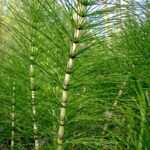
Horsetail is a perennial with hollow, jointed stems: robust sterile aerial shoots (typically pale green, 50–100 cm) and smaller fertile stems bearing sporangia. The plant is notable for a high mineral and trace element content, chiefly silica, and also contains potassium, calcium, iron, vitamin C, sterols, phenolic acids and flavonoids such as quercetol. These constituents are commonly cited in relation to traditional uses: minerals and silica for remineralizing associations, phenolics and flavonoids for antioxidant activity, and vitamin C for supporting collagen synthesis and general antioxidant balance.
- Silica: major mineral constituent often highlighted for connective tissue and remineralizing associations.
- Potassium: essential mineral present in plant tissue.
- Calcium: mineral contributing to the overall mineral profile.
- Iron: trace mineral found in horsetail.
- Vitamin C: antioxidant involved in collagen synthesis.
- Sterols: plant sterols present in extracts.
- Phenolic acids: phenolic compounds with antioxidant properties.
- Flavonoids (e.g., quercetol): antioxidant flavonoids found in the herb.
Silica is the primary compound emphasized in horsetail supplements, concentrated mainly in the sterile aerial stems used for preparations.
Related Herbs
Properties & Effects
Horsetail is traditionally known for practices related to mineral support, increased urinary output and assistance with bleeding or minor wounds. Its diuretic use for supporting urinary function is among the most widely recognized traditional applications.
- Remineralizing: may support maintenance of bones, cartilage and connective tissues.
- Diuretic: traditionally used to promote urine production and support minor urinary complaints.
- Hemostatic: traditionally used to help reduce bleeding in minor injuries.
- Wound healing: may support closure and repair of small skin wounds.
Dosage & How to Use
Practical dosing guidance and common usage notes for horsetail preparations reported in traditional sources and studies.
| Remineralizing |
|
|---|---|
| Diuretic |
|
| Hemostatic |
|
| Wound healing |
|
Safety, Side Effects & Contraindications
Horsetail is not suitable for everyone; specific groups should avoid internal use and care should be taken to use the correct species. People with certain fluid‑retaining conditions, young children and pregnant or breastfeeding people are explicitly advised against use according to traditional safety guidance.
Mild adverse effects have been reported with excessive intake, such as digestive upset or skin reactions, and prolonged use beyond recommended short courses may increase the risk of vitamin B1 (thiamine) deficiency and excessive potassium loss because of the plant’s diuretic activity. Caution is advised when combining horsetail with conditions or medications that affect fluid or electrolyte balance; drink ample fluids during treatment and consult a healthcare professional for personalised advice.
- Edema from renal or cardiac disease: avoid use due to potential fluid and electrolyte concerns.
- Children under 12 years: not recommended for use.
- Pregnancy and lactation: avoid as a precaution.
- Species identification: ensure use of Equisetum arvense only; some related species (for example Equisetum palustre) can be toxic.
- Treatment duration: limit internal use to short courses (do not exceed 4 weeks).
- Long-term use risks: prolonged use may contribute to vitamin B1 deficiency and excessive potassium loss.
Avoid horsetail if you have edema from kidney or heart disease, are pregnant, breastfeeding, or under 12; some related species can be toxic — consult a healthcare professional before use.