
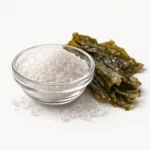
Iodine
Essential trace mineral involved in thyroid hormone production.
Iodine is a chemical element (atomic number 53) and an essential trace mineral involved in thyroid hormone synthesis. Found naturally in seawater and marine foods and commonly added to iodized salt, iodine participates in production of thyroxine (T4) and triiodothyronine (T3) and plays roles in reproduction and cognitive development.
Requirements vary by life stage and geography, with higher needs during pregnancy and lactation, and deficiency remains a concern in inland regions and diets high in processed foods. Iodine status is often assessed by urinary iodine (ioduria), and dietary sources or supplements such as potassium iodide are used to meet recommended intakes; uses and effects may vary by individual.
At a Glance
A naturally occurring halogen, iodine is an essential micronutrient concentrated in marine environments and required for thyroid hormone production. Dietary sources include seaweed, seafood, dairy and iodized salt, and supplements are commonly supplied as iodide (for example potassium iodide).
| Common name |
|
|---|---|
| Scientific name | I (elemental iodine) |
| Origin |
|
| Active compounds |
|
| Main benefits |
|
| Available forms |
|
Origin & History
Iodine is a naturally occurring halogen concentrated in seawater, marine sediments and the tissues of seaweeds and seafood; in its elemental form it appears as dark violet crystals. It is relatively scarce in many inland soils and mountainous regions, so dietary availability varies geographically and depends largely on marine-derived foods or fortified products.
Discovered by Bernard Courtois in 1811 and named by Louis-Joseph Gay-Lussac, iodine has been used historically in both medical and industrial contexts. Widespread iodization of table salt was adopted as a public-health strategy to reduce iodine deficiency and the prevalence of goiter. Other historical and contemporary uses include topical antiseptics, radiology contrast media and, in emergency situations such as nuclear incidents, administration of stable iodine to limit thyroid uptake of radioactive iodine.
Composition & Active Compounds
Elemental iodine is a dark violet to black crystalline solid and in the environment it commonly appears as iodide ions dissolved in seawater and concentrated in marine organisms. The main chemical constituents relevant to supplementation are iodine and iodide, the forms that provide the bioavailable element used for physiological functions. Iodide, commonly provided as potassium iodide, is the form most used in supplements.
- Iodine: elemental crystalline halogen present in seaweed and salts
- Iodide (e.g. potassium iodide): ionic form commonly used in supplements and iodized salt
Related Herbs

Properties & Effects
Iodine is traditionally known for its central role in supporting thyroid-related physiology and functions that influence growth and development. The most well-documented role of iodine is supporting thyroid hormone production and maintaining thyroid balance.
- Thyroid support: may support healthy thyroid hormone levels and normal thyroid function.
- Metabolic regulation: may support normal metabolic rate and energy regulation.
- Neurodevelopment: may support development of the nervous system and cognitive function, particularly during early life stages.
- Growth and development: may support normal physical growth and maturation.
- Reproduction: may support reproductive health and increased needs during pregnancy and lactation.
- Digestive function: may support normal digestive processes.
Dosage & How to Use
Dosage recommendations vary by age and life stage and should be adapted to individual needs.
| Infants (0 to 6 months) | 90 µg |
|---|---|
| Infants (7 to 12 months) | 110 µg |
| Children (1 to 3 years) | 90 µg |
| Children (9 to 13 years) | 150 µg |
| Adolescents (14 to 18 years) | 150 µg |
| Adults | 150 µg |
| Pregnant women | 200 to 230 µg |
| Lactating women | 260 to 290 µg |
| Urinary iodine (ioduria) target | ~150 µg |
| Deficiency threshold | Less than 25 µg |
| Safety limit | 600 µg |
Safety, Side Effects & Contraindications
Some people should avoid or use iodine with caution, particularly those with known allergy or hypersensitivity and people who have or are at risk of hyperthyroidism, since supplemental iodine can aggravate thyroid overactivity. Individuals taking certain medications that contain or increase iodine exposure may also require medical supervision before changing iodine intake.
Iodine is generally well tolerated at recommended intakes, but side effects are principally associated with excessive intake (yodism) and can include thyroid dysfunction. Overload is more commonly linked to medications than to usual dietary intake, so clinical context and individual variation determine safety; seeking personalized medical advice is appropriate when there are concerns.
- Allergy or hypersensitivity: Some people may develop allergic responses to iodine.
- Hyperthyroidism: Iodine supplementation can worsen existing hyperthyroid conditions.
- Overdose (yodism): Excessive intake may cause toxicity and thyroid disturbance.
- Amiodarone interaction: The antiarrhythmic drug amiodarone is frequently associated with excessive iodine exposure and increased risk of overload.
May worsen hyperthyroidism and interact with iodine-containing drugs such as amiodarone; consult a healthcare professional before using iodine supplements or changing intake.